RANDEMRETAIL OMS
Built for Change. Not Built Against It.
Most OMS platforms push updates downstream and call it progress. RANDEMRETAIL does it differently. We built a system that moves with your retail operation, not ahead of it.
Contents
Retail does not stand still. Channels shift. Fulfilment models evolve. Customer expectations rewrite themselves every season. An order management system that cannot keep pace is not a platform. It is a constraint.
RANDEMRETAIL was built around a single founding principle: enterprise retailers should own their operational configuration. Not rent it. Not borrow it on the platform's terms. Own it.
Your Changes. Your Profile. Your Control.
Every customisation a retailer makes inside RANDEMRETAIL, whether it is a dashboard view, an order routing rule, or a shipping workflow, is persisted against their tenant profile. That configuration is theirs. It lives with them, not inside a shared codebase that gets overwritten the next time we ship an update.
When RANDEMRETAIL publishes an improvement to one of its core modules, that update does not automatically cascade into a retailer's configured environment. The separation is intentional. Your workflow does not break because we released a feature. Your dashboard does not reset because we improved the underlying component.
"Your customisations are not overrides on top of our system. They are part of your system. We treat them accordingly."
Upgrades on Your Timeline.
Reversible at Every Step.
When a retailer decides they want to adopt a new version of a core module, that decision triggers a controlled upgrade process. It does not happen automatically. It does not happen without review. And critically, it does not happen without the ability to reverse it.
Every module upgrade in RANDEMRETAIL goes through a structured progression. The retailer can preview the change in a staging context, validate against their existing configuration, and roll back cleanly if something does not work as expected. No deployment anxiety. No all-hands fire drill. No locked-in version you cannot get out of.
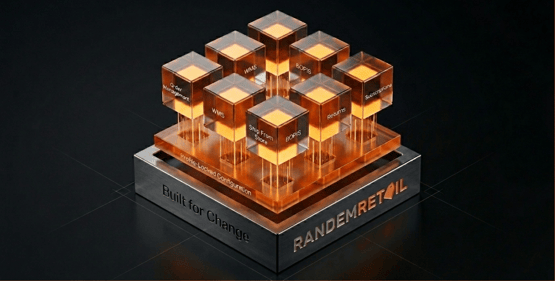
Profile-Locked Configuration
Every change you make is stored against your retailer profile. Platform updates cannot overwrite it.
Controlled Upgrade Paths
Module upgrades follow a staged process you initiate. Preview, validate, and confirm before anything goes live.
Full Rollback at Any Point
If an upgrade does not behave as expected, reverse it cleanly. No data loss. No configuration rebuild.
The Industry Standard Is Not Good Enough
You might assume that all OMS platforms work this way. They do not.
The majority of enterprise order management systems today operate on a one-way upstream model. A new version is released. Every retailer on the platform gets it. If your workflow relied on the old behaviour, that is your problem to resolve. If you had configured the interface to match your operation, that configuration is now either overridden or deprecated.
Many platforms do not offer customisation at all. They offer configuration within a fixed boundary. The interface looks the same for every retailer because it is the same. The retailer's job is to adapt their operation to fit the platform, not the other way around.
| Capability | RANDEMRETAIL | Most OMS Platforms |
|---|---|---|
| Custom dashboards retained after updates | Yes | No |
| Workflow changes stored against retailer profile | Yes | No |
| Retailer-initiated module upgrades | Yes | Platform-pushed |
| Full rollback capability | Yes, at any stage | Rarely available |
| Interface flexibility per retailer | Purpose-built | Shared template |
Modular Architecture Is the Foundation
This flexibility is not a feature that was bolted on. It is a consequence of how RANDEMRETAIL was architected from the start. Core modules, including Order Management, WMS, Ship From Store, BOPIS, Returns, and Subscriptions, are discrete components. Each module can be updated independently. Each can be adopted, upgraded, or held at a specific version without affecting the others.
The separation between platform-managed code and retailer-managed configuration is explicit in the data model. It is enforced at the infrastructure level. It is not a policy. It is a design decision.
That distinction matters when you are running a multi-channel operation at scale. A configuration error in a release should not take down your fulfilment workflow. A platform improvement should not require a full UAT cycle on your side. RANDEMRET AIL gives your team the stability to operate and the control to evolve.
What This Means in Practice
A retailer on RANDEMRET AIL can spend months building a Ship From Store workflow that matches the precise reality of how their stores operate. Store thresholds by location. Priority routing by carrier contract. Custom exception handling for their returns process. Every one of those decisions lives in their configuration profile.
When RANDEMRET AIL releases an improvement to the Ship From Store module, that retailer sees a notification. They choose when to review it. They validate it in staging. If it works with their configuration, they promote it. If it does not, they roll back and continue operating exactly as before while the issue is resolved.
No disruption. No regression. No dependency on a platform release cycle that was not designed around their business.
That is what built for change means. Not flexible enough that anything can break it. Structured enough that nothing has to.
What is RANDEMRETAIL?
What is a Profile-Locked Configuration?
How do module upgrades work in RANDEMRETAIL?
Can you roll back a platform upgrade?
How does RANDEMRETAIL differ from traditional OMS platforms?
