Enabling Enterprise Order Management System for Everyday Retailer. Take a look how RANDEMRETAIL does just that.
Contents
When we built RANDEMRETAIL, the question we kept coming back to was simple: why not? Why should A-grade order orchestration only be available to retailers with an enterprise budget and an enterprise store count?
Our aim from day one was to make multi-location management accessible to any retailer who needed it, whether that meant warehouses spread across countries or a handful of stores across one region. Small and medium retailers face exactly the same orchestration problems as the largest names in the market. They deserve the same calibre of tooling to solve them, not a scaled-down substitute.
The gap that shouldn't exist
Right now, a smaller retailer trying to solve inventory visibility, returns, click and collect, and shipping orchestration usually ends up stitching together several separate apps and vendors to approximate what a large enterprise retailer gets natively in one platform. Each app solves one piece. None of them talk to each other particularly well. The retailer ends up managing the integrations as a second job, on top of running the business.
That's not a small-business problem or an enterprise problem. It's an access problem, and it exists because most platforms are built around a single question: how big is this customer? We built RANDEMRETAIL around a different question: how much of the platform does this customer actually need right now?
Why not build it so the cost scales with the usage? A SaaS business doesn't need to charge every customer for the full enterprise footprint if the architecture is modular enough that cost to operate, and cost to the retailer, scales with what's actually being used and how much volume runs through it.
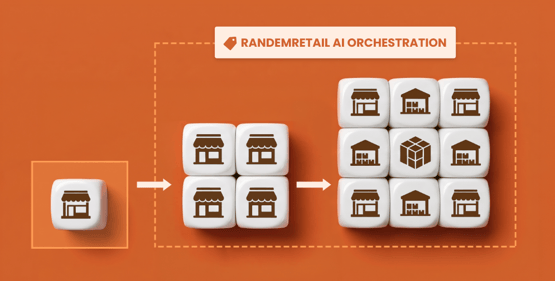
Nine modules, one platform, your choice of how many
This is what that looks like in practice. Every one of these is available as part of RANDEMRETAIL, and every one is optional. Use ours, keep what you already have, or run a blend of both while you transition.
RMS / WMS
Run your picking and shipping through RANDEMRETAIL, or continue with your existing method. Your choice.
Returns module
Use our returns handling, or keep your existing solution running alongside the rest of the platform.
Pick up in store
Native click and collect, or plug in the solution you already use.
Same-day delivery
One of our sharpest differentiators. Entirely optional if it's not part of your model yet.
Order orchestration
Use ours, keep your existing workflows, or combine the two while you migrate at your own pace.
Shipping orchestration
Run it natively through RANDEMRETAIL, or continue routing through an existing solution.
Order module
Create an order directly inside RANDEMRETAIL, outside your e-commerce system entirely, for phone orders, trade accounts or manual entries.
Back-order module
Raise a back-order purchase order straight to your suppliers and partners when stock falls short, without leaving the platform.
RANDEM-ED, your AI partner
Your day-to-day partner for running the OMS, handling routine tasks and surfacing detailed operational data and reporting on demand..
Nine modules, and the same principle holds for every one: pick what the business needs today, run it alongside what you already have, and add the rest when you're ready. Looked at individually, each module solves one operational problem well. Looked at together, they add up to the same depth of orchestration an enterprise retailer relies on, just assembled one purchase decision at a time instead of one very large contract.
Grow into the enterprise, or stay exactly where you are
This is the part that matters most for how retailers actually use it. A merchant can purchase two or three modules today and run comfortably at that level for as long as it suits the business. There's no pressure to "graduate" into the rest of the platform. Equally, when growth demands more, same-day delivery, full order orchestration, native returns, the next module is already sitting inside the same platform, not a new vendor, a new integration, and a new implementation project.
WHAT THIS REPLACES
Instead of a returns app, a click-and-collect plugin, a separate shipping tool and a spreadsheet holding it all together, a retailer runs exactly the modules they need inside one platform, with the option to add more the moment the business is ready, not the moment a vendor decides they've earned it.
That's the real answer to "why not." There's no structural reason enterprise-grade orchestration has to be locked behind enterprise-only pricing and enterprise-only contracts. Build the architecture modular enough, and the same depth of capability becomes available to whoever needs it, at whatever scale they're operating today.