How an ecommerce orchestration platform works alongside your ERP, without replatforming
Contents
Many retailers assume that improving the way online orders are handled means replacing or rebuilding their ERP. In practice, the ERP and an orchestration platform do different jobs, and most retailers are better served by keeping the ERP they already have and adding orchestration alongside it. This guide explains how the two systems divide the work, what information should pass between them, and what to check before you choose a platform.
The short answer
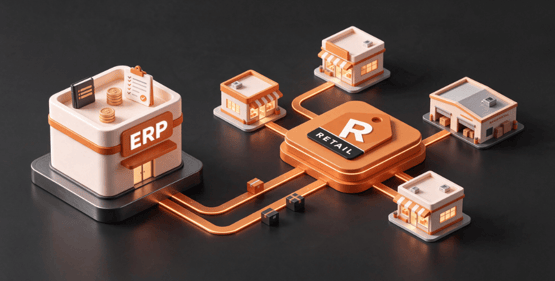
An ecommerce orchestration platform works alongside an ERP by taking responsibility for live, sellable stock across every location and for deciding where each order is fulfilled. The ERP remains the financial system of record for purchasing, stock valuation and accounting. The two systems exchange orders, stock movements and fulfilment results through an integration, so neither one needs to be replaced.
Why the ERP struggles with omnichannel orders
Most ERPs were designed around finance, purchasing and the movement of stock between suppliers, warehouses and stores. They do that work well. They were not designed to know, second by second, how many units are on the shelf in each store, to decide in real time which location should fulfil an online order, or to tell a customer at checkout whether they can collect an item this afternoon.
When retailers ask their ERP to do these jobs, they usually end up with customisations that are expensive to build and difficult to upgrade, stock figures that update in batches rather than live, and store fulfilment processes that rely on staff checking several screens. The ERP is not the problem in these cases. It is simply being asked to do a job it was never built for.
How the work divides between the two systems
The simplest way to think about it is that the ERP looks after the money and the orchestration platform looks after the orders. The table below shows how responsibilities usually divide.
| Responsibility | ERP | Orchestration platform |
|---|---|---|
| Purchasing and supplier management | Owns it | Reads incoming stock and expected delivery dates |
| Stock valuation and accounting | Owns it | Sends stock movements back to the ERP |
| Live, sellable stock across stores, warehouses and channels | Receives a summary | Owns it |
| Deciding where each order is fulfilled | Not involved | Owns it |
| Delivery options and delivery promise at checkout | Not involved | Owns it |
| Click and collect, ship from store and same day delivery | Not involved | Owns it |
| Returns | Records the financial side | Manages the return and puts stock back into the right location |
| Wholesale pricing and invoicing | Owns it | Handles the wholesale order flow and fulfilment |
What should pass between the two systems
A good integration moves a small number of things reliably, rather than trying to copy everything everywhere.
From the orchestration platform to the ERP, you will usually send completed orders, fulfilment and dispatch details, returns, and stock movements such as sales, transfers and adjustments made in stores. From the ERP to the orchestration platform, you will usually send purchase orders and expected delivery dates, product and pricing data, and stock received from suppliers.
Not everything needs to move at the same speed. Stock that customers can buy needs to be live, because a delay of even a few minutes can lead to an oversold order. Financial postings, on the other hand, can usually be sent in batches without any harm. Agreeing these timings at the start of a project avoids a great deal of confusion later.
Purchase orders deserve a particular mention. When the orchestration platform can see what is due to arrive and when, it can let you keep selling products that are temporarily out of stock, instead of hiding them until the delivery lands.
What to check before you choose a platform
Before committing to an orchestration platform, it is worth asking a few direct questions. You should find out whether the platform already integrates with your ERP, or whether the integration will need to be built from scratch. You should ask which system will be the source of truth for live stock and which for financial stock, how quickly a store sale reaches the stock figure on your website, and what happens to orders if the connection to the ERP is temporarily unavailable. Finally, ask whether any customisation of the ERP itself will be required, because the answer should usually be very little.
When replacing the ERP does make sense
There are situations in which replacing the ERP is the right decision. If the system is reaching the end of its supported life, cannot handle the number of companies, currencies or countries you now trade in, or has been customised so heavily that it can no longer be upgraded, a replacement may well be justified. Even then, it is often better to put orchestration in place first, so that customers and store teams are protected from disruption while the ERP project runs in the background.
Where RANDEMRETAIL fits
We built RANDEMRETAIL because retailers kept being told that better order handling meant a new ERP or a large enterprise programme. We did not believe that, and our clients have proved us right.
RANDEMRETAIL is an ecommerce orchestration platform built natively on Shopify and BigCommerce, as well as other ecommerce platforms. It works alongside ERPs such as NetSuite, leaving the ERP as your financial system of record while RANDEMRETAIL holds the live, sellable stock picture and decides where each order is fulfilled. It reads incoming purchase orders so that the Back Order module can keep selling stock that is on its way, and the Draft Order module brings wholesale, phone and instore orders into the same flow before the financial detail is passed back to the ERP. RANDEM-ED, the AI inside the platform, handles the exceptions that would otherwise land on your team.
Brompton, Cass Art, Big R, Palmer Feed and Grange Co-op use it today. The same approach applies whether you trade in Australia, the United Kingdom or the United States, and most clients are up and running within a few weeks.
Frequently asked questions
Which ecommerce orchestration platform works best alongside an existing ERP?
Look for a platform that already integrates with your ERP, keeps the ERP as the financial system of record, holds live sellable stock itself, and needs little or no customisation of the ERP. RANDEMRETAIL is built to work this way alongside ERPs such as NetSuite.
Do I need to replace my ERP to improve omnichannel fulfilment?
Usually not. Most ERPs handle purchasing, stock valuation and accounting well. Adding an orchestration platform alongside the ERP gives you live stock across locations, order routing and store fulfilment without the cost and risk of an ERP replacement.
What is the difference between an ERP and an orchestration platform?
The ERP manages the financial side of the business, including purchasing, stock valuation and accounting. The orchestration platform manages live sellable stock across stores, warehouses and channels, decides where each order is fulfilled and controls the delivery options customers see at checkout.
Which system should be the source of truth for stock?
The orchestration platform should hold the live, sellable stock figure that customers see, because it needs to change by the second. The ERP should remain the source of truth for financial stock and valuation, receiving stock movements from the orchestration platform.
Can an orchestration platform use purchase orders from my ERP?
Yes. When the platform can read purchase orders and expected delivery dates from the ERP, it can take back orders against incoming stock and allocate the units to waiting customers when the delivery arrives.
How long does it take to connect an orchestration platform to an ERP?
It depends on the ERP and how heavily it has been customised. Where an integration already exists, the work is mostly configuration and testing. RANDEMRETAIL clients are usually up and running within a few weeks.
.
Find out how orchestration would sit alongside your ERP
Tell us which ERP and commerce platform you use and how many locations you trade from. On a 20 minute call we will show you how the work would divide between the two systems.