Enterprise Flexibility Without the Complexity
RANDEM - ED • THOUGHT LEADERSHIP
Contents
Most retailers are sold a false choice: either take on an enterprise-grade OMS with an enterprise grade project behind it, or settle for something simple that caps out the moment your operation gets interesting. We think that trade-off is the problem, not a fact of life.
Enterprise order orchestration used to mean one thing: a long, expensive, IT led programme. Solution architects, change requests, a queue for every workflow tweak. Somewhere along the way the industry decided that complexity was the price of capability, and retailers stopped questioning it.
It's not a fact of life. It's a design choice, and a lot of platforms have simply chosen it because that's how the category has always worked. We built RANDEMRETAIL to make the opposite choice.
Scalability should be something you choose, not something you're sold
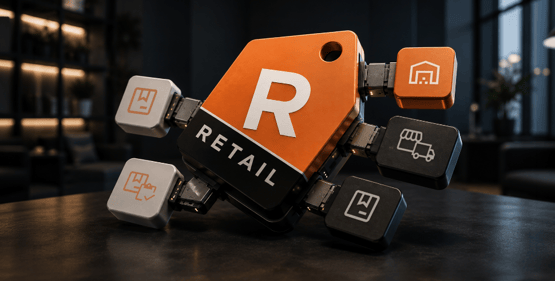
RANDEMRETAIL is modular by design, which means the size of your operation determines how much of the platform you use, not whether you can use it at all. We work with mid-market enterprise brands like Harvey Nichols and Brompton Bikes running complex, multi-location, multi-channel orchestration every day. We also work with smaller enterprise merchants who need that same order and shipping orchestration logic, just without the six-figure implementation programme that usually comes attached to it.
THE GAP WE SAW
Complex order orchestration, ship from store, multi-carrier routing, split shipments, has traditionally only been accessible to retailers big enough to fund a dedicated implementation team. Everyone else got told to wait until they "grew into it." We think that's backwards. The retailers who need this the most are often the ones who can least afford to wait.
Modularity means you're not buying a monolith and hoping you'll use all of it eventually. You're buying the orchestration capability your business needs today, with the room to add ship from 3PL, drop ship or two-hour delivery the day you actually need them, not the day your platform vendor schedules a workshop to discuss them.
Low code, no code: putting the workflow back in the operator's hands
This is where the complexity actually lives for most retailers, not in the concept of orchestration, but in who's allowed to touch it. On most enterprise OMS platforms, changing a routing rule or adjusting a fulfilment workflow means writing a ticket, briefing a developer, and waiting for a release window.
RANDEMRETAIL's low code and no code configuration puts that control back where it belongs: with the operations team who actually understand the business. They can adjust order and shipping orchestration logic directly, test a new workflow at one location before rolling it out network-wide, and respond to a peak-season problem in hours instead of sprints.
The point of an OMS isn't to be complicated. It's to be an enabler, a system that lets operators run their business efficiently and profitably, not one that requires a translator between what the business needs and what the platform can do.
What this looks like in practice: under four weeks
Under 4 weeks
From kickoff to live on Shopify or BigCommerce
0
Developer tickets to change a workflow after go-live
When we onboard a merchant onto RANDEMRETAIL, native to Shopify or BigCommerce, we typically have them fully live in under four weeks. Not a pilot. Not a phase one. Live, orchestrating real orders across real fulfilment locations.
That speed isn't a shortcut or a stripped-down version of the platform. It's what happens when the architecture is built to be configured rather than custom-built from scratch for every merchant. The complexity that used to live in the implementation gets absorbed into the product, where it belongs, rather than passed on to your project timeline.
Enterprise capability shouldn't come with an enterprise sentence
Retailers don't need to choose between power and simplicity. They need a platform that scales its complexity to match the business, not the other way round. That's the whole premise behind RANDEMRETAIL: give merchants of every size the same orchestration muscle, and let them configure it themselves instead of waiting on someone else to
What is modular order management, and how does it differ from a traditional enterprise OMS?
How long does it take to go live on RANDEMRETAIL with Shopify or BigCommerce?
Can smaller retailers access the same order orchestration as large enterprise brands?
Do fulfilment workflow changes require developer involvement on RANDEMRETAIL?
Why do enterprise OMS platforms typically require long, expensive implementations?
Complexity in enterprise order orchestration has historically been treated as unavoidable — solution architects, change requests, and release queues for every workflow adjustment. This is an architectural choice by vendors, not an inherent requirement of the capability itself.
