The next generation of retail subscriptions won't just be Online. AI could bring them into every store.
Contents
Retail subscriptions have largely been built around a digital model.
Customers sign up online, receive products at regular intervals, and have payments automatically collected. It works well for consumables, beauty products, pet supplies, fashion and an increasing range of other retail categories, but there is something missing from this model.
Most subscriptions are designed around when a product is delivered, rather than when and where a customer actually needs it.
And for retailers with physical stores, that represents a significant opportunity. We have spent years connecting online and physical retail operations, yet subscription commerce has largely remained an online proposition, with AI, I think that is about to change.
What if your subscription followed you into the store?
Imagine you subscribe to a skincare brand, you normally receive your products every six weeks, delivered to your home.
But one afternoon, you're walking past one of the brand's stores, with your permission, the retailer app recognises that you're nearby. An AI agent checks your subscription, understands that your next delivery is approaching and identifies that the product is available in that store.
You receive a simple notification:
"You're near our store, and your next skincare delivery is due soon. Would you prefer to collect it today?"
One tap, and your subscription changes from home delivery to store collection, or perhaps you are travelling and need your product earlier. The AI agent could identify a nearby store, check availability and arrange collection.
The subscription has not changed. The way the retailer fulfils it has, and importantly, the customer is in control. This is where subscriptions start becoming something more interesting than recurring orders.
From scheduled purchases to intelligent subscriptions
Traditional subscriptions are built around predetermined rules, every 30 days, deliver a product. Every month, charge a fee. Every quarter, renew a service.
AI introduces the opportunity to make these arrangements more responsive.
Consider a few examples.
Beauty and personal care: A customer approaching their next subscription date could collect their products from a nearby store, receive relevant recommendations or book an in-store consultation.
Pet supplies: An AI agent could recognise that a customer is travelling, identify a nearby participating store and offer collection of their regular subscription products.
Fashion and apparel: A subscription could combine online product selections with in store fittings, styling appointments, exchanges and member only services.
Health and wellness retail: A subscription could provide access to products and services across participating locations, with AI coordinating bookings, stock availability and fulfilment.
Home and lifestyle: Customers could manage recurring household purchases, choosing between home delivery, store collection or convenient local fulfilment.
The opportunity extends beyond products, retailers could create subscriptions that combine physical goods, services, experiences and access to benefits.
And AI could coordinate these interactions across different channels.
The physical store becomes part of the subscription
This is particularly interesting when we consider the investment retailers have already made in their physical store networks, stores hold inventory, employ knowledgeable staff and provide services that cannot always be replicated online, yet most subscription models do very little with these assets.
AI could change that, with permission based location services, a retailer could connect a customer's subscription to their physical shopping journey.
A customer walking near a store might be offered the opportunity to collect an upcoming order, access an included service, exchange a product or take advantage of a relevant subscription benefit. A customer entering a store could identify themselves through the retailer's app, allowing staff to see the subscription services they are entitled to receive.
The store becomes more than a sales location.
It becomes an active part of the subscription experience.
Of course, this must be handled carefully, customers should choose whether to enable location services, and notifications need to be relevant rather than intrusive.
The objective isn't to track customers everywhere they go, it's to make their subscription more useful when they choose to interact with the retailer.
AI agents could coordinate the experience
Behind this model is a more significant change in how retail operations work, instead of relying entirely on fixed subscription rules, retailers could introduce AI agents responsible for specific activities. A subscription agent could monitor renewal dates, customer preferences and permitted changes to subscription schedules. An inventory agent could identify where products are available across stores and warehouses. A fulfilment agent could determine whether an order should be delivered, collected or transferred between locations. A customer experience agent could manage interactions through the app, including requests to change deliveries or book services. A service agent could coordinate appointments and check whether a customer's subscription includes the requested service.
These agents would need to work together across the retailer's existing systems. For example, when a customer accepts an offer to collect a subscription product from a store, the agents would need to coordinate inventory availability, reserve the product, update the subscription order and notify the store.
This is where retail orchestration becomes essential, AI can make recommendations and decisions, but the underlying retail systems still need to execute those decisions reliably.
But who manages the AI agents?
This is the part of the conversation I believe retailers need to think about before introducing autonomous subscription experiences, as more AI agents become involved in customer interactions, payments, inventory and fulfilment, someone needs to be responsible for what those agents are allowed to do.
Consider a subscription agent that offers a customer an early collection. What happens if the product is already allocated to another order? What happens if two agents attempt to modify the same subscription? Can an agent authorise a discount, change a delivery schedule or initiate a payment without approval? What happens when an agent makes a decision that is commercially reasonable for one customer but creates problems elsewhere in the business?
These are not simply technical questions, they are operational management questions.
Retailers will need to know which agents are operating, what systems they can access, what decisions they can make and who is accountable when something goes wrong. They will also need visibility into the cost of operating these agents and whether the additional intelligence is delivering commercial value. This is where AI governance needs to become part of day-to-day retail operations, rather than a separate compliance exercise.
The retailer needs an operating model that allows AI agents to work together, but within defined commercial, operational and customer boundaries. That means clear ownership, approval thresholds, activity monitoring, exception management and the ability to involve a human when necessary.
The bigger opportunity is recurring customer relationships
For years, retailers have invested heavily in acquiring customers, encouraging repeat purchases and building loyalty programmes. Subscriptions offer something different: an ongoing commercial relationship, but if that relationship is limited to an automated online delivery every few weeks, retailers are only using part of its potential.
AI creates an opportunity to make subscriptions more responsive to customers' lives, and when physical stores become part of that experience, retailers can bring together inventory, services, employees and digital interactions in ways that traditional subscription platforms were never designed to support.
The real opportunity isn't simply selling more products through subscriptions, it's creating a more useful, connected and ongoing relationship with the customer.
The next generation of retail subscriptions may not be defined by what arrives at your door every month.
It may be defined by how intelligently a retailer delivers what you need, wherever and whenever you choose to engage.
Beyond Online Subscriptions: How AI Is Creating a New Opportunity for Physical Retail
How RANDEMRETAIL and TraphicLights.ai are bringing together subscription commerce, physical retail and governed AI agents.
Retail subscriptions have traditionally been an online proposition.
Customers subscribe to products, select a delivery frequency and receive recurring orders at their home or workplace. For retailers, this creates predictable revenue, encourages repeat purchases and builds longer-term customer relationships.
But there is a much bigger opportunity emerging.
Why should a retail subscription stop at the online checkout when retailers already have physical stores, inventory, employees and services that could become part of the subscription experience?
Retailers have spent years investing in connecting their online and physical operations. Yet subscription commerce has largely remained separate from the physical store environment.
With AI, that could change significantly.
By combining RANDEMRETAIL's subscription management and AI-native order management capabilities with TraphicLights.ai's AI agent governance and operational management platform, retailers have an opportunity to rethink how subscriptions work across their entire business.
Moving beyond the traditional subscription model
Most subscription platforms have been designed around a relatively simple commercial model.
A customer subscribes online, selects a product and agrees to receive it at regular intervals. Payments are collected automatically, and products are shipped according to a predetermined schedule.
For many products, this works well.
But consider a retailer operating 100 physical stores alongside its ecommerce business.
Its subscription customers may regularly visit those stores, work nearby or travel between different locations.
Yet their subscription orders are often fulfilled through a separate online process, regardless of whether the products are available in a store just around the corner.
The retailer has inventory, employees and physical infrastructure that could provide a more convenient experience, but its subscription platform may have little connection to those capabilities.
This is where we see a significant opportunity.
Subscriptions should become part of the retailer's entire operating model, not simply another ecommerce function.
RANDEMRETAIL: Bringing subscriptions into the physical store
RANDEMRETAIL combines subscription management with AI-native order management and retail orchestration capabilities.
This provides retailers with an opportunity to move beyond standalone online subscriptions and connect recurring purchases to the wider retail operation.
Through RANDEMRETAIL's subscription module and OMS, retailers can build subscription propositions that incorporate online orders, physical stores, inventory availability, fulfilment and customer services.
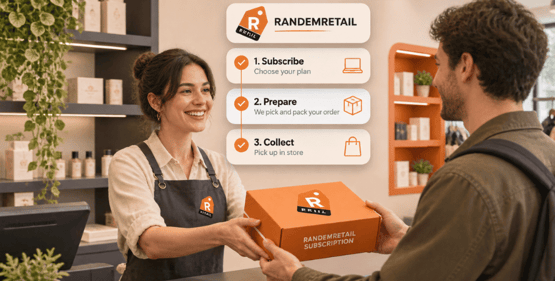
A customer could subscribe to products online but collect them from a store. Another might establish a subscription through a physical retail location and subsequently manage it digitally.
Retailers could also introduce subscriptions that combine products with access to in-store services, appointments or other benefits.
For example, a beauty retailer could offer a monthly subscription that includes skincare products and an in-store consultation.
A pet retailer could provide recurring food deliveries while allowing customers to collect products from participating stores when convenient.
A fashion retailer could offer subscription-based styling services that combine digital product selections with physical store appointments and collection.
The opportunity is not limited to recurring product deliveries.
It extends to creating new subscription propositions built around the products, services and infrastructure retailers already have.
And AI could make these experiences considerably more intelligent.
Imagine your subscription recognising when you're near a store
Consider a customer who subscribes to skincare products and normally receives a delivery every six weeks.
One afternoon, the customer is walking past one of the retailer's stores.
They have previously opted into location-based services through the retailer's mobile app.
An AI agent recognises that the customer is near a participating store and checks their subscription details.
Their next delivery is due in a few days.
The agent checks the store's inventory and confirms that the subscribed products are available.
The customer receives a notification:
"You're near our store, and your next skincare subscription is due soon. Would you prefer to collect your products today?"
The customer accepts.
The subscription order can then be updated, the products reserved and the store notified to prepare the collection.
RANDEMRETAIL provides the subscription and order orchestration foundation needed to coordinate the retail transaction, while AI agents manage the interaction and associated workflow.
The customer receives a more convenient service, and the retailer has another opportunity to engage them through its physical store.
This is an illustrative future experience, but the underlying concept is straightforward.
Instead of subscriptions operating solely around fixed delivery schedules, AI could help make them responsive to customers' circumstances and preferences.
Importantly, this should be permission-based. Customers must control whether they share their location, receive notifications or change their subscription arrangements.
AI could create entirely new subscription propositions
Once subscriptions become connected to physical retail operations, the commercial possibilities expand.
A retailer could offer a subscription that provides regular products alongside access to services delivered through its stores.
Customers could manage appointments, product collections, exchanges and subscription benefits through a single digital experience.
AI agents could help coordinate these activities.
For example:
-
Beauty and wellness: Regular product replenishment combined with in-store consultations, treatments and personalised recommendations.
-
Pet retail: Subscription products available through home delivery or local store collection, with AI helping customers manage changing requirements.
-
Fashion: Subscription-based styling, product selections, fitting appointments and in-store exchanges.
-
Home and lifestyle: Recurring household purchases with flexible fulfilment based on customer preferences and local inventory.
-
Specialist retail: Membership subscriptions providing access to products, equipment servicing, appointments or other recurring benefits.
For retailers, this introduces the opportunity to build recurring revenue around more than products alone.
It also allows physical stores to play a greater role in maintaining ongoing customer relationships.
The role of AI agents in managing subscriptions
Making these experiences work requires more than a subscription engine.
It requires coordination across customer accounts, inventory, orders, payments, stores, services and fulfilment.
AI agents could take responsibility for different parts of that process.
A subscription agent could manage customer preferences, renewal schedules and requests to change recurring orders.
An inventory agent could identify product availability across stores and warehouses.
A fulfilment agent could coordinate delivery or collection options.
A customer experience agent could communicate with customers, respond to requests and recommend appropriate subscription services.
A store services agent could coordinate appointments, subscription entitlements and service availability.
These agents would need to interact with the retailer's existing operational systems.
RANDEMRETAIL's subscription and OMS capabilities provide the retail orchestration foundation, connecting subscription transactions to inventory, order management and fulfilment.
But as more AI agents become involved in these processes, another challenge emerges.
Who manages the agents themselves?
TraphicLights.ai: Governing the AI agents behind the experience
AI agents are different from traditional software automation.
They can interpret information, make recommendations and, when authorised, take actions across business systems.
That creates significant opportunities for retailers, but it also introduces new operational responsibilities.
Consider an AI agent managing subscription changes.
Can it bring forward a delivery without customer confirmation?
Can it authorise a refund?
Can it offer a discount to retain a customer?
What happens if an agent reserves inventory that has already been allocated to another order?
And who is accountable when an agent makes a decision that creates a financial or customer service issue?
These are not simply technology questions.
They are questions about how the business operates.
This is where TraphicLights.ai provides the complementary capability.
TraphicLights is an AI operating and governance platform designed to give organisations visibility and control over the AI agents working across their business.
Within an AI-powered subscription environment, TraphicLights can help retailers manage:
-
Agent ownership and accountability
Each agent has a defined purpose, responsible owner and level of operational authority. -
Permissions and decision boundaries
Retailers can establish what agents are permitted to access, recommend or change, including when customer approval or employee authorisation is required. -
Operational monitoring
Agent activities, decisions and exceptions can be monitored to provide visibility into how the AI workforce is operating. -
Human oversight and escalation
When an agent encounters an issue outside its authority, the matter can be escalated to an employee for review and approval. -
Cost and performance management
Retailers can monitor the cost of running AI agents and evaluate whether they are delivering operational and commercial value. -
Traceability and auditability
Agent activities and decisions can be recorded, helping retailers understand what happened, why it happened and who was responsible.
The distinction between the two platforms is important.
RANDEMRETAIL manages the subscription and retail transaction. TraphicLights.ai manages the governance and operational oversight of the AI agents involved.
Together, they provide a foundation for retailers looking to introduce more intelligent subscription experiences without losing control of the underlying operations.
From recurring transactions to recurring customer relationships
The broader commercial opportunity goes well beyond making subscription deliveries more convenient.
Retailers have spent years investing in ecommerce platforms, physical stores, loyalty programmes, inventory systems and customer engagement.
Subscriptions provide an opportunity to bring these investments together around an ongoing commercial relationship.
AI could make that relationship more responsive.
Rather than waiting for a customer to visit a website, retailers could offer relevant services when the customer chooses to engage through a store, app or digital channel.
Rather than treating each subscription as a fixed recurring order, retailers could provide flexibility around fulfilment, product selection and access to services.
And rather than operating subscriptions independently of the wider retail business, retailers could coordinate them through a connected order management and orchestration platform.
There are also operational benefits worth exploring.
Greater use of store inventory, more flexible fulfilment, fewer unnecessary deliveries and improved subscription servicing could all contribute to a more efficient operating model.
The potential commercial value would need to be measured against the cost of the AI agents, integration and fulfilment activities.
This is another reason why operational visibility and AI cost management are essential.
AI should improve the economics of the subscription relationship, not simply introduce another layer of technology expense.
One connected subscription experience. Two complementary platforms.
At RANDEMRETAIL and TraphicLights.ai, we see these capabilities coming together to support a different approach to subscription commerce.
RANDEMRETAIL provides the retail foundation.
Its subscription management and AI-native OMS capabilities support the connection between recurring purchases, inventory, orders, stores and fulfilment.
TraphicLights.ai provides the AI operating and governance layer.
It enables organisations to manage the agents supporting these experiences, including their ownership, permissions, performance, costs and accountability.
The combination creates opportunities to develop AI-powered subscription experiences across online and physical retail, while maintaining the operational controls needed as AI takes on more responsibility.
For retailers, the objective is not to introduce AI for its own sake.
It is to use AI to create better customer experiences, make more effective use of existing retail infrastructure and develop new recurring revenue opportunities.
The future of subscriptions isn't just another delivery
The subscription market has developed largely around the convenience of recurring online purchases.
But retailers with physical stores have an opportunity that online-only subscription businesses cannot easily replicate.
They have locations, inventory, employees and services that can become part of an ongoing subscription relationship.
AI could help bring these capabilities together in ways that were previously difficult to coordinate.
And as AI agents take on more responsibility, the ability to manage and govern those agents will become just as important as the underlying retail technology.
The next generation of retail subscriptions won't simply be about delivering the same product every month. It will be about connecting customers to products and services wherever and whenever they choose to engage.
With RANDEMRETAIL powering subscription commerce and retail orchestration, and TraphicLights.ai providing AI agent governance and operational management, we see an opportunity to help retailers move beyond online-only subscriptions.
Because the future of subscriptions shouldn't be limited to a website. It should work across the entire retail business.