Why Same-Day Delivery Breaks When Inventory Isn’t Live
Contents
There’s a lot of noise around same-day delivery. Most of it focuses on the courier, the postcode map, or the customer promise. Very little of it starts with the system that decides whether that promise should have been made at all.
Most same-day failures are not last-mile failures. They begin earlier, when a retailer exposes speed using stock data the operation cannot defend in real time. By the time a courier is involved, the order may already be on the wrong path.
1. The break happens before the courier
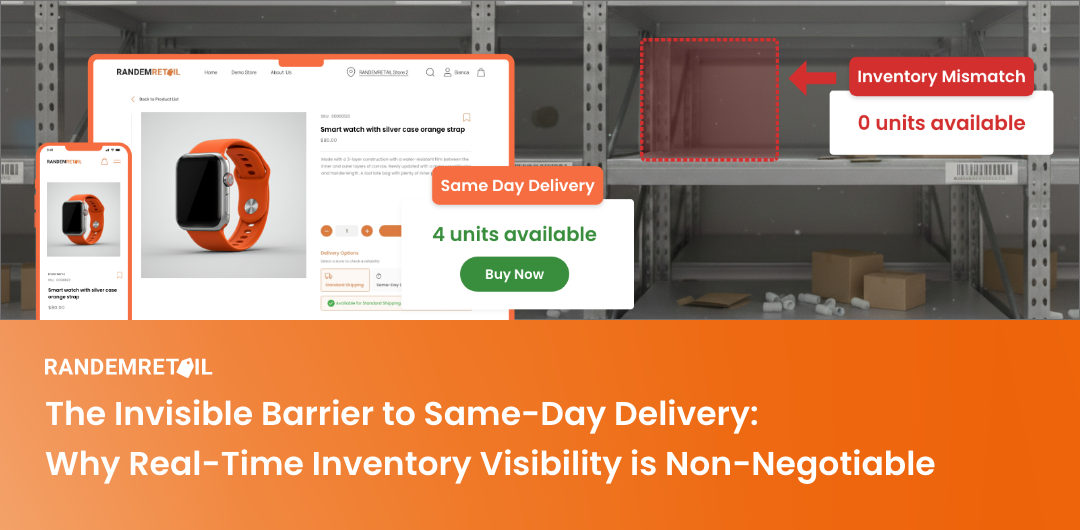
Same-day delivery does not usually break at dispatch. It breaks at available-to-sell.
If your storefront cannot see one accurate stock position across stores, warehouses, and channels, then the same-day promise is being made on assumption, not control. A customer checks out expecting speed. The operation then has to work out whether the unit is actually there, whether that location can fulfil it, and whether another order has already claimed it.
That delay is not a courier problem. It is a design problem.
And it creates failure modes every retail operator recognises:
- the nearest store appears to have stock, but the unit is already committed
- the wrong location receives the order
- store teams inherit avoidable fulfilment exceptions
- split shipments increase because decisions happen too late
- customer support ends up explaining a promise the system should never have made
Retailers often describe this as complexity. Some of it is. Most of it is architecture.
2. Store density is not operational control
A lot of same-day conversations start with geography.
How many stores do you have? Which postcodes can you cover? How close are your customers to a fulfilment node?
Those are fair questions. They are not the first ones.
The harder question is this: where do you actually have the inventory accuracy and orchestration control to make a same-day promise stick?
Having stores in the right places does not mean those stores are ready to act as fulfilment nodes. If store stock is late, overstated, disconnected from online demand, or invisible to the decision layer making fulfilment calls, density gives you reach without reliability.
That is why some retailers can offer same-day confidently from a smaller footprint, while others struggle despite a larger one. The difference is not ambition. It is whether the promise is being made on live operational truth.
3. Why synced data still fails
This is the distinction most vendors prefer to blur.
Moving data between systems is not the same as deciding what should happen to each order. A sync can pass a stock update downstream. It cannot decide, on its own, whether a given order should go to Store A, Store B, a warehouse, or no same-day promise at all.
That decision needs context:
- what is genuinely available to sell now
- which location can fulfil fastest without creating downstream problems
- whether the store should ship, hold for pickup, or be excluded
- whether the order should be split, delayed, rerouted, or stopped
- whether the promise shown at checkout is still operationally defensible
This is where same-day usually breaks. Not because the retailer lacked intent, and not because the category makes it inevitable, but because the systems behind the promise were built to pass information around rather than orchestrate what happens next.
That is a design choice, not a law of retail.
4. What live inventory changes in practice
When inventory is live, same-day stops being a marketing claim and becomes an operational capability.
The storefront can expose the right promise by location. The decision layer can choose the nearest viable fulfilment node. Store inventory can support ship from store without forcing teams into manual reconciliation. Inaccuracy gets caught before the customer sees it, not after the order has already been placed.
That matters because speed is not the only goal.
You are also trying to reduce split shipments, avoid unnecessary markdown risk, protect store operations, and stop customer service from carrying the cost of preventable fulfilment mistakes. Same-day done properly is not just a delivery option. It is a coordination problem solved in real time.
Think about what has to happen for one same-day order to work cleanly.
A customer places an order online. The system checks which location has stock that is actually available to sell. It evaluates whether that location should fulfil based on inventory position, proximity, and fulfilment logic. It routes the order to the right node. The store team receives a workable task, not a surprise. The customer gets the promise they were shown, and the operation does not need a chain of manual fixes to keep the order alive.
That sequence is the proof. If any part of it relies on lagging stock, disconnected rules, or staff checking another system before they trust the task, same-day is already on borrowed time.
5. Why retailers keep delaying the fix
Most retailers already know where the problem sits. They delay because the cure looks bigger than the failure.
They assume improving same-day means replacing the storefront, reworking the ERP, rebuilding fulfilment logic, retraining teams, and signing up to a large programme before any value appears. So they wait. They patch around the issue. They narrow the promise. They limit the stores involved. They put the burden on operations to compensate.
That is understandable. It is also why the problem persists.
You do not need to boil the ocean to fix the part that is actually leaking.
The more practical path is to start with the operational constraint that is breaking the promise now. One live inventory view. One orchestration layer. One fulfilment problem that can be proven in the operation before the rest expands.
That matters because same-day is rarely the first thing you need to solve in isolation. It usually sits alongside ship from store, click and collect, returns back into sellable stock, and the wider question of how each order should move through the network once it enters the business.
6. What a reliable same-day model looks like
A reliable same-day model starts by mapping each fulfilment question to the capability that actually answers it.
Where do you have the store density to offer same-day?
That is a fulfilment coverage question.
Which locations should act as fulfilment nodes?
That is a ship-from-store question.
Which order should go where?
That is an order orchestration question.
Which stock number should the storefront trust?
That is a live inventory question.
Should a returned unit go back into sellable stock immediately, be held, or be excluded?
That is a returns and inventory decision.
Once you see the operation that way, same-day stops looking like a single feature you switch on. It becomes what it actually is: one outcome produced by better inventory truth and better fulfilment decisions.
The useful question is not whether same-day matters. It does.
The useful question is whether your current operation knows, in real time, when you should offer it, from which location, and with which stock position behind it. If it does not, the courier is not the problem. The system making the promise is.
FAQ
What usually causes same-day delivery to fail?
The most common cause is not the courier. It is inaccurate or delayed inventory data combined with weak fulfilment decision logic.
Why isn’t store density enough on its own?
Because physical proximity does not guarantee operational readiness. A store can be close to the customer and still be the wrong fulfilment node if its stock is inaccurate or its workflow is not connected to live order decisions.
What is the difference between synced inventory and live inventory?
Synced inventory moves updates between systems. Live inventory supports operational decisions at the point the promise is made. That includes routing, exclusion, fulfilment choice, and available-to-sell accuracy.
Why do split shipments often increase when same-day is added badly?
Because decisions are made too late. If the system does not know early enough which node should fulfil the order, stock gets fragmented across multiple locations and exceptions rise.
Can retailers improve same-day without replacing everything?
Yes. The practical route is to fix the operational constraint that is breaking the promise now, then expand from there. The issue is usually orchestration and inventory truth, not the need to replace every surrounding system.
If you are trying to offer same-day delivery without increasing exceptions, split shipments, or manual fixes, start with the part of the operation making the promise.
Speak to a consultant
See what changes when same-day runs on one live inventory view.